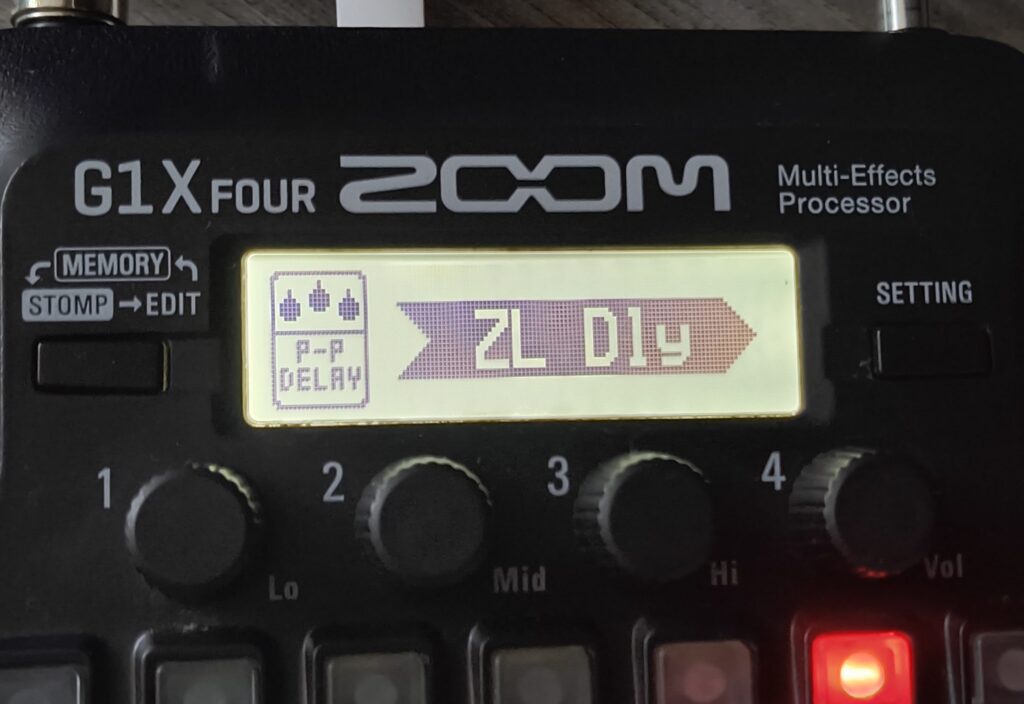
I wanted a ping-pong delay where the dry signal doesn’t sit in the middle. The stock one couldn’t do it, so I went poking at the effect files, with an AI assistant doing a lot of the heavy lifting. Here’s how far that got me, including the part where it crashed.
The itch
Ping-pong delays are great, but the stock one in my G1X Four plays the dry guitar in the center and the echoes bounce around it. I wanted the first hit hard left, then right after the delay time, then left again. Add a plate reverb on top and that’s the dream pedal.
You can’t set this up in the menus, so the question became: can I change the effect itself?
What an effect file actually is and how I got in
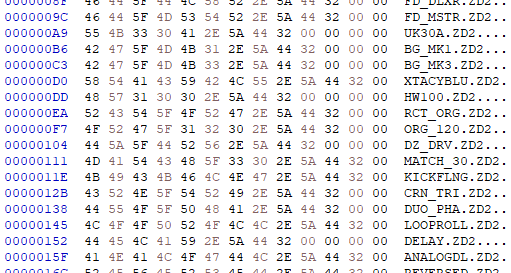
Before touching any code, I had to figure out what I was looking at. The effects on this pedal are .ZD2 containers. Using community-documented tools, I exported the effect files right out of my own pedal. Opening one up turned out to be less scary than expected: it contains a small header with the name, icon, description, and a DSP load number, a plain ELF binary built for a TI C6000-family DSP, a descriptor table listing the knobs, a JSON blob describing parameters for the editor app, and a CRC checksum at the end to keep the pedal happy.
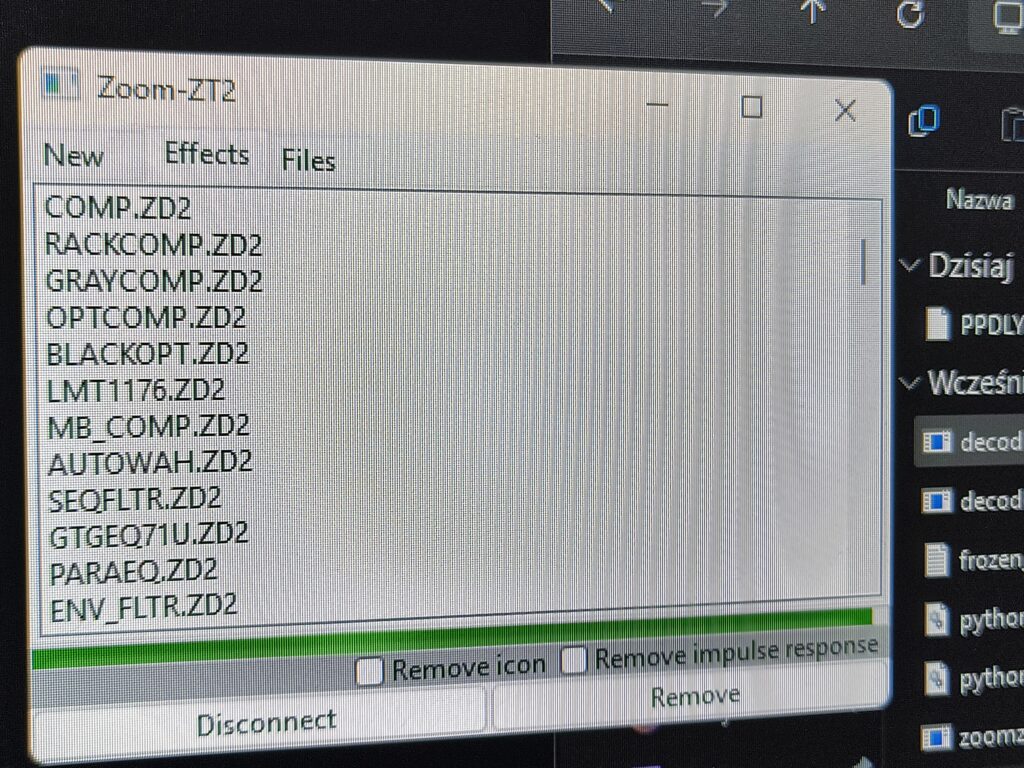
With the help of an AI assistant to handle the heavy lifting of reading disassemblies and working out file structures, I installed TI’s free compiler tools for the C6000 family to dig into the binary. To avoid bricking the hardware immediately, we even wrote a small assembler and a toy emulator to test glue code safely off-device.
Step one: a one-instruction mod
In the delay’s audio routine, the wet and dry signals get mixed per channel, and the dry term for the right channel was handled by a single multiplication instruction. Pointed straight to the target by the AI, we replaced that one instruction with a simple “load zero”.
That was it. No center, and the sequence went L, delay, R, delay, L, exactly what I wanted. After fixing the checksum and renaming the binary, I loaded it onto the pedal, and it worked on the first try.
Step two: trying to cram delay and reverb into one slot (and failing)
A reverb in the same slot is nicer than burning two, so we tried merging the delay with the stock Plate reverb. Since both effects process audio in place, the idea was to write a tiny hand-assembled wrapper calling the delay and then the reverb sequentially, splitting the available memory regions and updating the parameter tables.
It turns out that fitting two complex DSP algorithms into the memory constraints of a single slot is a bridge too far, or at least beyond my current patience :P. The version with reverb ran for a moment and then made the pedal stutter and freeze due to memory stomping. Trimming regions didn’t save it, proving that the hardware has hard limits and some boundaries just aren’t meant to be forced. Still, it’s pretty awesome that with a little help from AI, you can tweak the behavior of existing effects and tailor them precisely to your needs.
Lessons so far
- Test small. One-instruction patches teach you more than ambitious rewrites.
- A tiny emulator for your own glue code is worth the hour it costs.
- Hardware has hard limits. Sometimes a single slot just doesn’t have the headroom for two heavy algorithms.
- AI speeds up the boring parts a lot, but you still need the hardware, the patience and a healthy suspicion of anything untested.